

TL;DR:
- Choosing the right beginner sailboat depends on your sailing environment, crew size, and goals, with dinghies and daysailers best for small crews and coastal cruising suits families. A structured approach to shortlisting, combined with practicing essential sail handling skills and reefing routines in calm conditions, maximizes safety and confidence. Systematic planning and expert support accelerate learning, making the transition into sailing enjoyable and safe for newcomers.
Choosing your first sailboat is one of the most consequential decisions you will make as a new sailor, yet most beginners approach it with a dangerously simple assumption: that any boat will do. The reality is that the wrong choice can drain your budget, sap your enthusiasm, and even put you in genuine danger. Get it right, however, and your first season on the water becomes a masterclass in confidence, seamanship, and pure enjoyment. This guide walks you through every practical framework you need, from understanding boat categories to mastering essential sail handling skills, so that your first vessel genuinely serves your goals.
Table of Contents
- Understanding beginner sailboat categories and sail plans
- How to shortlist and evaluate beginner boats
- Essential sail handling skills for new sailors
- Reefing made simple: Safety and troubleshooting for beginners
- Case spotlight: Jeanneau Sun Odyssey 415, a modern beginner choice
- Why system-thinking beats improvisation for beginner sailors
- Your next step: Try beginner sailing with expert support
- Frequently asked questions
Key Takeaways
| Point | Details |
|---|---|
| Match your boat to your experience | Choosing the right type and size of sailboat dramatically improves the learning curve and safety for new sailors. |
| Practise core skills safely | Start with checklists and short shakedown sails to build confidence before tackling challenging conditions. |
| Reef early and use routines | Follow a reliable reefing sequence to avoid accidents and handle sudden wind changes with control. |
| Consider all ownership costs | Factor in ongoing expenses like maintenance, storage, and insurance when budgeting for your first boat. |
| Guided experiences accelerate learning | Professional charter or training opportunities provide structured support that speeds up novice progress. |
Understanding beginner sailboat categories and sail plans
Before you even look at a listing or visit a boatyard, you need to understand that sailboats are not interchangeable. A coastal cruiser and a racing dinghy may both have sails, but they demand entirely different skill sets, budgets, and ambitions. Getting this wrong is the single most common and costly mistake among first-time buyers.
The three categories most relevant to beginners are dinghies, daysailers, and coastal cruisers. A dinghy is a small, open, lightweight boat, typically under six metres, that responds immediately to every shift in your body weight and wind angle. This sensitivity makes it an outstanding teaching tool. A daysailer is slightly larger, often between five and nine metres, and is designed for comfortable outings without overnight accommodation. A coastal cruiser is a keeled vessel capable of multi-day voyages with a cabin, galley, and sleeping berths, but it demands a steeper learning curve to handle well.
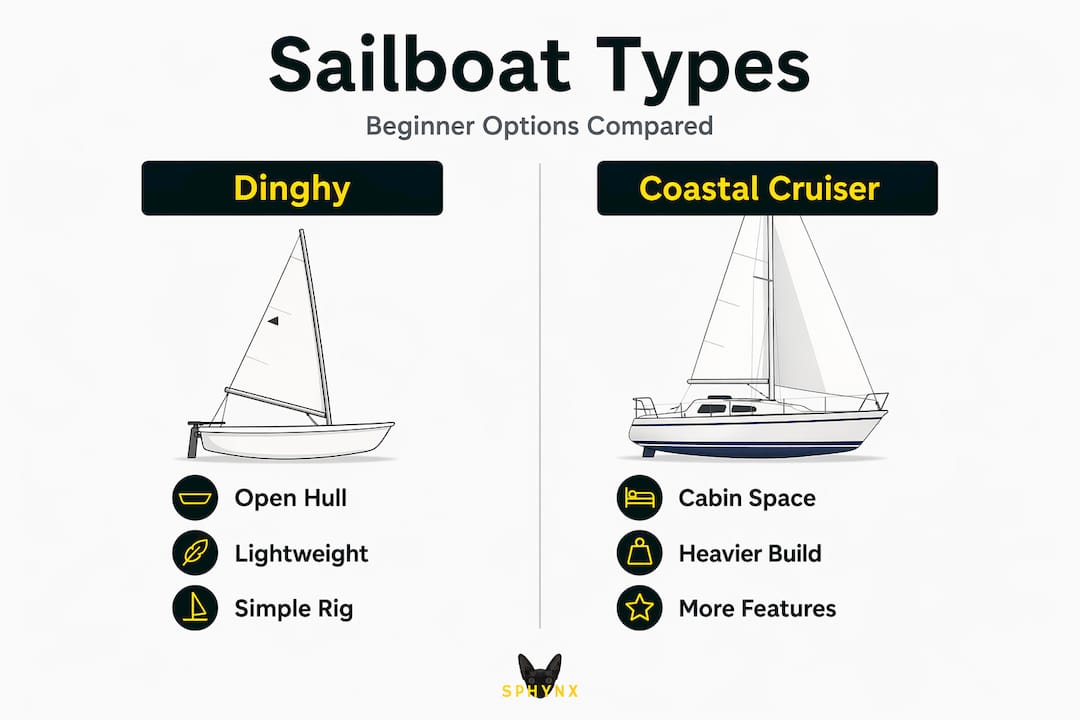
Keel type is another foundational variable. Fin keels offer agile manoeuvring and suit most beginners exploring sheltered coastal waters. Full keels provide steadiness in heavy weather but are slower to respond and better suited to offshore passages. Practical Sailor recommends narrowing your first-boat shortlist around intended sailing, such as day use versus serious bluewater, and then choosing a keel type that fits that use. A recognised buyer-checklist approach also includes explicitly matching the boat to your experience level and your intended use before anything else.
Understanding comfort in sailboat layouts also helps you appreciate how cockpit design, winch placement, and sail plan complexity affect how quickly a beginner adapts to a vessel.
| Boat type | Best for | Keel type | Sail complexity |
|---|---|---|---|
| Dinghy | Solo beginners, skill-building | Centreboard | Simple, sloop rig |
| Daysailer | Small crews, sheltered water | Fin keel | Moderate, sloop/cutter |
| Coastal cruiser | Family, overnight sailing | Fin or full keel | Moderate to high |
Key questions to ask yourself before choosing a category:
- Where will you sail most often, a lake, an estuary, or open coastal waters?
- Will you usually sail alone, or with a crew of two to four?
- Do you want to race, cruise leisurely, or simply learn the basics?
- How much time can you realistically commit to maintenance?
Pro Tip: Avoid the temptation to overbuy. Many enthusiastic beginners purchase a coastal cruiser before they are ready and spend their first year stressed rather than learning. Start with the smallest boat that genuinely fits your use case, build competence, then upgrade with informed confidence.
How to shortlist and evaluate beginner boats
With clear categories in mind, you now need a structured process for narrowing your options. Emotion is a powerful force in any boat purchase, but it rarely serves your long-term interests as a beginner.
A buyer-checklist approach includes budgeting for ongoing costs alongside the purchase price. This is critical because a cheap boat with high annual mooring and maintenance fees can quickly become unaffordable. Practical Sailor also highlights that matching a keel type to your sailing location is as important as the hull design itself. You may also find beginner-friendly sailing experiences enormously useful at this stage, giving you a feel for different vessel types before you commit to owning one.
Follow this numbered process to keep your shortlisting rational and grounded:
- Define your sailing area first. Sheltered inland waters, coastal day trips, and Mediterranean passages each demand different vessel sizes and keel designs.
- Set a total budget, not just a purchase price. Include mooring fees, insurance, annual maintenance, and any safety equipment upgrades you will need in year one.
- Determine your typical crew size. A two-person crew can manage most daysailers comfortably; a family of four needs at least a small coastal cruiser with adequate deck space.
- Assess your storage and trailering needs. Dinghies and small daysailers can be trailered home, which saves significant marina costs.
- Inspect any shortlisted boat with a qualified marine surveyor before purchase. Even a seemingly sound second-hand vessel can hide osmotic blisters, rigging fatigue, or engine problems that cost thousands to resolve.
- Take each shortlisted boat for a sea trial. Never buy a sailing vessel without testing it in real conditions, even in light wind.
| Feature | Small daysailer | Coastal cruiser | Jeanneau Sun Odyssey 415 |
|---|---|---|---|
| Length | 5 to 7 m | 9 to 12 m | 12.6 m |
| Crew size | 1 to 2 | 2 to 6 | 2 to 6 |
| Overnight capability | No | Yes | Yes |
| Beginner suitability | Excellent | Moderate | Good with guidance |
| Typical annual maintenance | Low | Moderate to high | High |
Pro Tip: Think hard about where and how you actually want to sail before you get distracted by features and finishes. A beautiful interior is irrelevant if you plan day sails on sheltered water and never spend a night onboard.
Essential sail handling skills for new sailors
Selecting the right boat is only half the equation. You also need to build a reliable foundation of sail handling skills before you take the helm in anything beyond light conditions. Skill gaps cause the vast majority of avoidable incidents on the water, and the good news is that all the core skills are learnable in calm, controlled settings.
Beginner sail handling training should prioritise low-risk practice and shakedown experience before committing to extended passages. A shakedown sail is simply a short, deliberate practice outing where you perform manoeuvres methodically rather than reactively. Think of it as a dress rehearsal for every scenario the sea might present.
The essential beginner manoeuvres to practise, in order of priority, are:
- Tacking: turning the bow through the wind so that the wind shifts from one side of the boat to the other.
- Jibing: turning the stern through the wind, a more powerful and risk-prone manoeuvre in strong breezes.
- Reefing: reducing sail area when wind strengthens, a critical safety skill covered in detail in the next section.
- Man overboard recovery: a choreographed sequence every crew member should rehearse, not just understand in theory.
- Coming alongside and anchoring: the practical bookends of every sailing trip, often where accidents happen to inattentive beginners.
Tacking and jibing improvement depends on coordinated crew roles and precise timing at sail-change moments. Poor coordination during a jibe, for instance, can send the boom swinging violently across the cockpit. Assigning clear roles before each manoeuvre reduces this risk dramatically.
“The sailor who practices in calm conditions is the one who stays calm when conditions are not.” This is the core principle of low-pressure skill-building, and it applies to every new sailor regardless of how quickly they progress.
Pro Tip: Practise every manoeuvre in calm, predictable conditions before you attempt it in challenging weather. Competence built slowly and deliberately in fair weather becomes automatic when conditions deteriorate.
Reefing made simple: Safety and troubleshooting for beginners
Reefing is the process of reducing the area of your mainsail when wind strength increases beyond comfortable limits. Many beginners understand this in principle but leave it too late in practice. Reefing early is one of the highest-return habits you can build in your first season.
UK Sailmakers stresses reef clew setup details and common beginner edge cases: tie reef ties so they are visually obvious, and always use a safety line if reefing for extended periods. Reefing should be practised as a checklist-driven routine, anticipating moments when the system feels jammed rather than simply forcing it. You can also refer to our guide to Mediterranean sailing safety for broader context on preparing for open-water conditions.
Follow this step-by-step reefing sequence:
- Head up slightly into the wind to reduce pressure on the sail and make the process safer.
- Ease the mainsheet so the mainsail is luffing gently, reducing load on the luff cringle (the reinforced eyelet at the front of the sail).
- Attach the tack cringle (the forward reefing point) to the boom hook or tack pin first.
- Take up the reef pennant on the clew (the aft reefing point), pulling it down firmly until the new clew is close to the boom.
- Re-tension the mainsheet and bear away to your desired heading.
- Tie the reef points (the small lines running through the sail) loosely around the bundled sail to keep it tidy and reduce windage.
“At night and in rising wind, a well-rehearsed reefing routine is the difference between a controlled situation and a genuine emergency. Practise it until it is boring.”
Common mistakes to troubleshoot:
- The reef pennant will not pull down: the sail may still have too much wind in it. Head up further before trying again.
- Reef ties look uneven after tying: check that you have connected the correct cringle points. Visual markers on reef ties prevent this.
- The boom drops excessively after reefing: your topping lift needs adjustment before you begin the process next time.
Pro Tip: Build and rehearse your own reefing checklist on paper before your first shakedown sail. Taping it inside a cockpit locker means you can refer to it under pressure without embarrassment or hesitation.
Case spotlight: Jeanneau Sun Odyssey 415, a modern beginner choice
To ground all the theory in something concrete, the Jeanneau Sun Odyssey 415 is worth examining as a real-world example. It has become a popular choice for sailors transitioning from daysailers to keelboat cruising, partly because it genuinely balances capability with approachability.
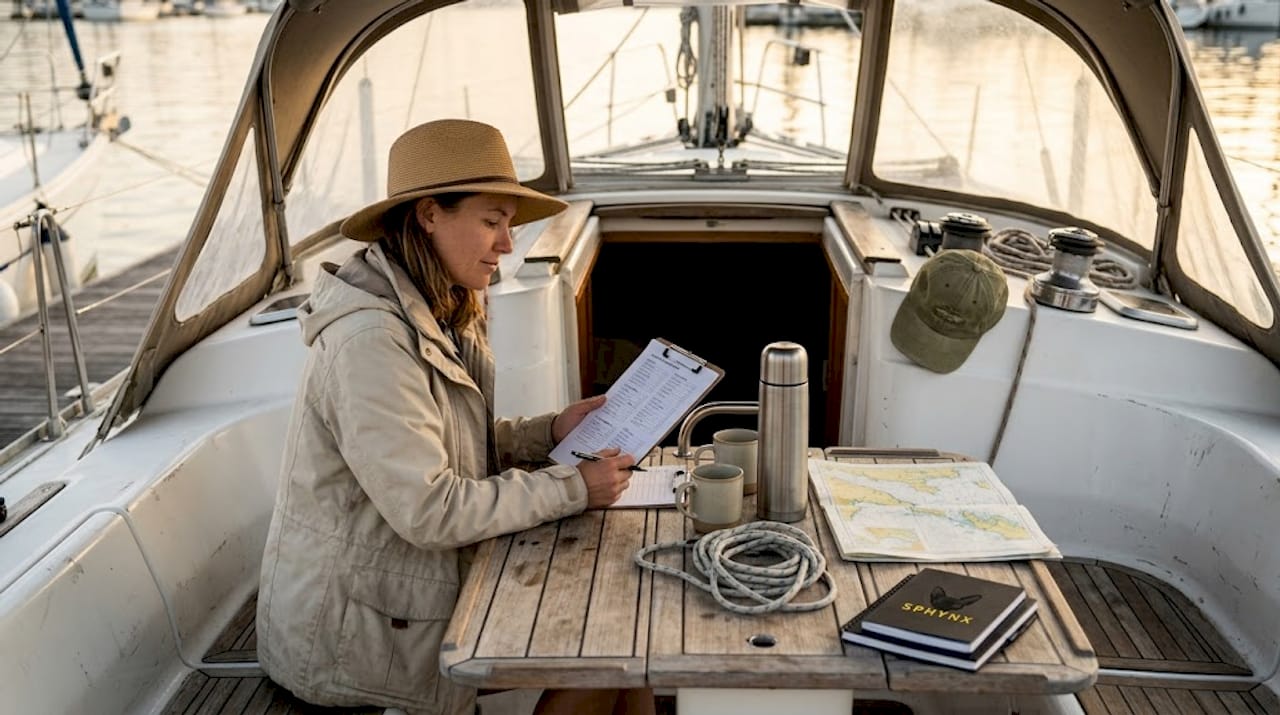
SAIL Magazine’s review of the Jeanneau Sun Odyssey 415 highlights beginner-friendly practicality features, including easy handling and versatility plus an arrangement that supports reefing with a small crew.
| Specification | Sun Odyssey 415 |
|---|---|
| LOA | 12.63 m |
| Beam | 4.20 m |
| Engine | 40 hp Yanmar diesel |
| Upwind sail area | 76.7 sq m |
| Cruising speed (engine) | 7 knots at 2,800 RPM |
| Reefing | Single-line slab reefing |
Key beginner-friendly features on this model include:
- All lines led aft to the cockpit, so the skipper can control sails without moving to the mast in rough conditions.
- A spacious, uncluttered cockpit that gives crew members room to move without crossing paths during manoeuvres.
- Slab reefing with a single control line, reducing the number of steps required to reef and minimising the margin for error.
- A performance sail pack option that upgrades the standard sails to carbon-reinforced versions, improving upwind efficiency without changing the handling characteristics.
The vessel is not truly a first boat for a complete novice sailing solo, but for a beginner with one or two introductory courses under their belt, crewing with a slightly more experienced companion, it represents a genuinely rewarding platform.
Why system-thinking beats improvisation for beginner sailors
Having worked through boat categories, shortlisting frameworks, core skills, and reefing routines, there is a deeper insight worth sharing: the sailors who progress fastest are rarely the most naturally gifted. They are the most methodical.
Most beginners dramatically overestimate how much intuition can accomplish on the water. Intuition develops over hundreds of hours of repetition. Until that foundation exists, systems do the work. Checklists, shakedown routines, and repeatable manoeuvre sequences solve the majority of beginner mishaps because they remove the need to improvise under pressure.
The counterintuitive truth is that structure sets you free on the water. A sailor who pre-briefs every manoeuvre, assigns crew roles in advance, and refers to a laminated card when reefing does not look less capable than a freewheeling improviser. They simply make fewer mistakes. And fewer mistakes mean more enjoyment, more progress, and more confidence to push boundaries gradually.
Even experienced offshore sailors who have crossed oceans use pre-departure checklists and structured watch routines. They have not abandoned systems because they became expert. They became expert partly because they never abandoned systems. If you take one thing from this guide, let it be this: build your process first, and the intuition will follow naturally with time on the water.
Your next step: Try beginner sailing with expert support
Reading about sailing builds knowledge. Actually sailing in a supported, structured environment builds genuine competence far more quickly than any amount of research alone. If you are ready to move from theory to experience, one of the smartest ways to accelerate your progress is to get aboard a professionally crewed vessel and observe real sail handling, communication, and decision-making in action.

At Sphynx BCN, we offer private yacht tours along the Barcelona coastline that are perfectly suited to sailors at every level, including complete beginners who simply want to feel what a well-handled yacht is like before committing to ownership. You can explore the full range of luxury sailing benefits and choose from several Barcelona yacht charter types that match your ambitions, schedule, and group size. The Mediterranean is one of the world’s great beginner sailing environments, and experiencing it properly, on a beautifully maintained vessel with expert guidance, is the fastest way to turn enthusiasm into ability.
Frequently asked questions
What is the best type of beginner sailboat for solo use?
Small daysailers or dinghies with simple rigging are ideal for solo beginners because they are light, manageable, and easy to rig and de-rig. For a structured overview, the buyer’s checklist confirms that small daysailers and dinghies suit beginners best.
How can a beginner avoid sailing accidents?
Practise short shakedown sails, use checklists, and only push beyond basic conditions after gaining confidence with key manoeuvres like tacking and reefing. Low-risk practice and shakedown experience are central to beginner safety.
Is a fin keel or full keel better for learning to sail?
Fin keels are generally best for beginners as they are easy to manoeuvre in sheltered waters, while full keels suit heavy weather and long-distance offshore use. Practical Sailor recommends a fin keel as the workable choice for most non-offshore beginners.
How do I know if I need to reef the sails as a beginner?
Monitor wind conditions and boat heel; reef early rather than late, and always follow a checklist to avoid errors under pressure. Checklist-driven reefing routines are the recommended approach for anticipating difficult moments before they escalate.
What recurring costs should I plan for with my first sailboat?
Budget for ongoing expenses including maintenance, mooring, insurance, and occasional upgrades in addition to the original purchase price. The full buyer’s checklist breaks these components down clearly so you can plan before you sign anything.