

Corporate team building has a reputation problem. Most HR professionals know the feeling: you book a workshop, rent a conference room, and watch your team go through the motions. The results rarely stick. Yet research into inclusive sailing shows that time on the water builds communication, trust, and mutual reliance in ways that no classroom exercise can replicate. This article breaks down exactly why sailing works as a team building tool, which skills it develops, how to design an event that delivers real results, and why diversity at sea translates directly into stronger performance back at the office.
Table of Contents
- Why sailing is a powerful team building tool
- How sailing develops core team skills
- Designing inclusive and effective sailing experiences
- Unlocking diversity and innovation at sea
- A fresh perspective on team building: what sailing reveals
- Transform your next team event with a luxury sailing experience
- Frequently asked questions
Key Takeaways
| Point | Details |
|---|---|
| Sailing accelerates team trust | Crews must rely on one another in real time, instantly building deeper trust than typical activities. |
| Unique skills are developed | Sailing hones adaptability, clear communication, and resilience through lived experience. |
| Inclusivity drives better outcomes | Diverse, inclusive crews show sustained performance gains and richer collaboration. |
| Expert planning is crucial | Matching personalities, setting realistic goals, and daily debriefs maximise the learning benefits. |
Why sailing is a powerful team building tool
Most corporate away-days follow a familiar pattern: a ropes course, a cooking class, or perhaps a quiz night. These activities are enjoyable, but they share one critical weakness. The stakes are not real. If someone fails to catch a ball or burns a risotto, nothing actually happens. The team laughs and moves on. Sailing is fundamentally different because the consequences of poor communication are immediate and visible to everyone on board.
When your team is navigating the Mediterranean off the coast of Barcelona, every instruction matters. A misunderstood command does not just slow the group down. It can send the boat off course, tangle the rigging, or create a safety concern. That real-time feedback loop is what separates sailing from almost every other team building format. You cannot fake collaboration on water. Either the crew works together or the boat does not move efficiently.
Consider the contrast between a standard offsite and a sailing experience:
| Factor | Standard offsite | Sailing experience |
|---|---|---|
| Real stakes | Low | High |
| Communication pressure | Moderate | Constant |
| Leadership visibility | Structured | Organic |
| Trust requirement | Optional | Essential |
| Adaptability demand | Minimal | Continuous |
The cohesion boost by sailing is not accidental. It is built into the very nature of the activity. Inclusive sailing programmes, which mix participants of different abilities including visually impaired and sighted sailors, demonstrate this most clearly. Communication skills become a core strength precisely because the environment demands them without exception.
“The sea does not care about your job title. It responds only to how well your crew communicates and trusts one another.”
For HR professionals, this is the key insight. Sailing strips away hierarchy and forces every participant to contribute authentically. The person who is quietest in meetings may turn out to be the most decisive navigator. That revelation alone can shift team dynamics for months after the event.
How sailing develops core team skills
Having seen why sailing stands out, let’s break down the specific skills your team will develop on board. Think of a sailing voyage as a compressed project lifecycle. There is a briefing phase, an execution phase full of unexpected variables, and a debrief that consolidates learning. This mirrors exactly how high-performing workplace teams operate.
Sequential teamwork is perhaps the most obvious parallel. Hoisting a sail requires one person to release the line, another to pull, and a third to secure the cleat at precisely the right moment. If anyone is out of sync, the task fails. This is identical to a product launch where marketing, operations, and sales must coordinate without gaps.
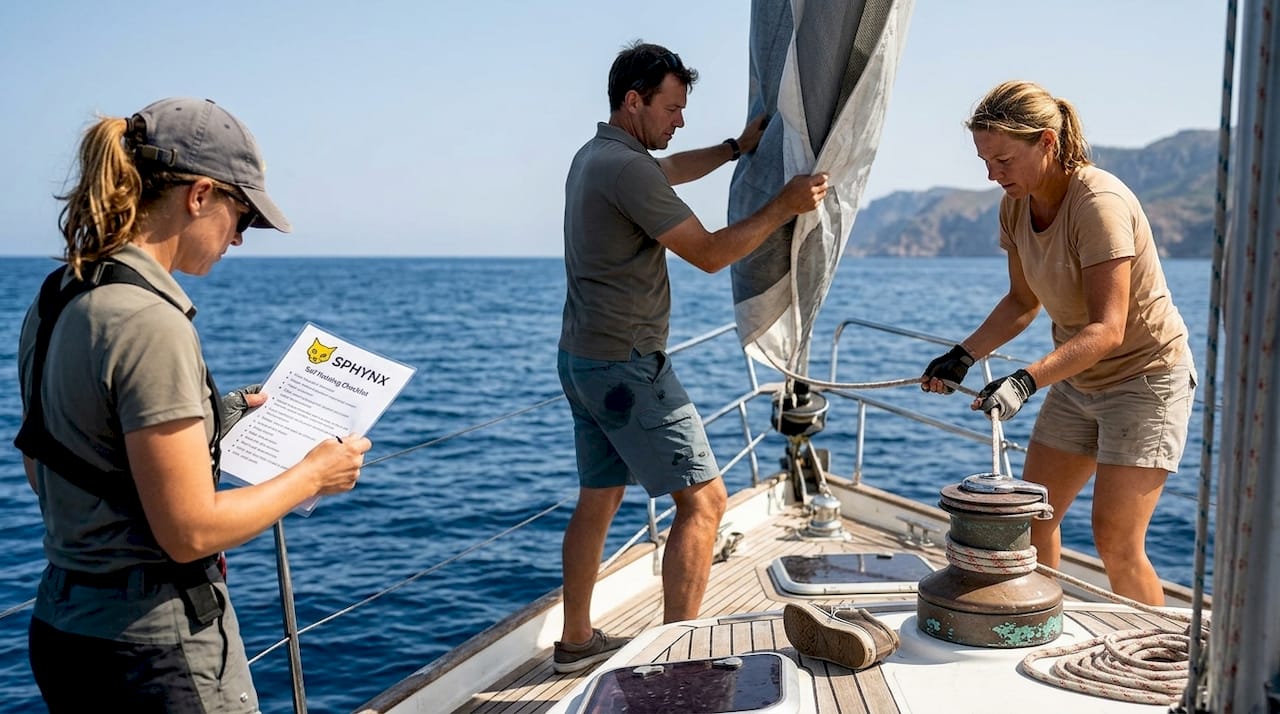
Handling unpredictable sea conditions is where adaptability gets tested. A sudden wind shift demands an immediate response. There is no time for a committee meeting. Team members must read the situation, communicate quickly, and act. Success relies on matching personalities, setting achievable goals, and running daily debriefs while sailing, which maps directly onto agile working practices that many organisations now prioritise.
Here are the core skills your team will sharpen during a sailing event:
- Communication: Clear, concise instructions under pressure with no room for ambiguity
- Adaptability: Rapid response to changing conditions without losing composure
- Problem-solving: Creative thinking when equipment, weather, or plans change unexpectedly
- Mutual reliance: Genuine trust that each crew member will fulfil their role
- Leadership: Organic emergence of leaders based on competence rather than seniority
- Active listening: Accurate reception of instructions in a noisy, dynamic environment
The numbers support this. 65% of participants report increased group cohesion following structured sailing activities, a figure that far outpaces the results from conventional team building formats. Pairing this with executive sailing retreats designed around leadership development creates a genuinely measurable return on your team building investment.
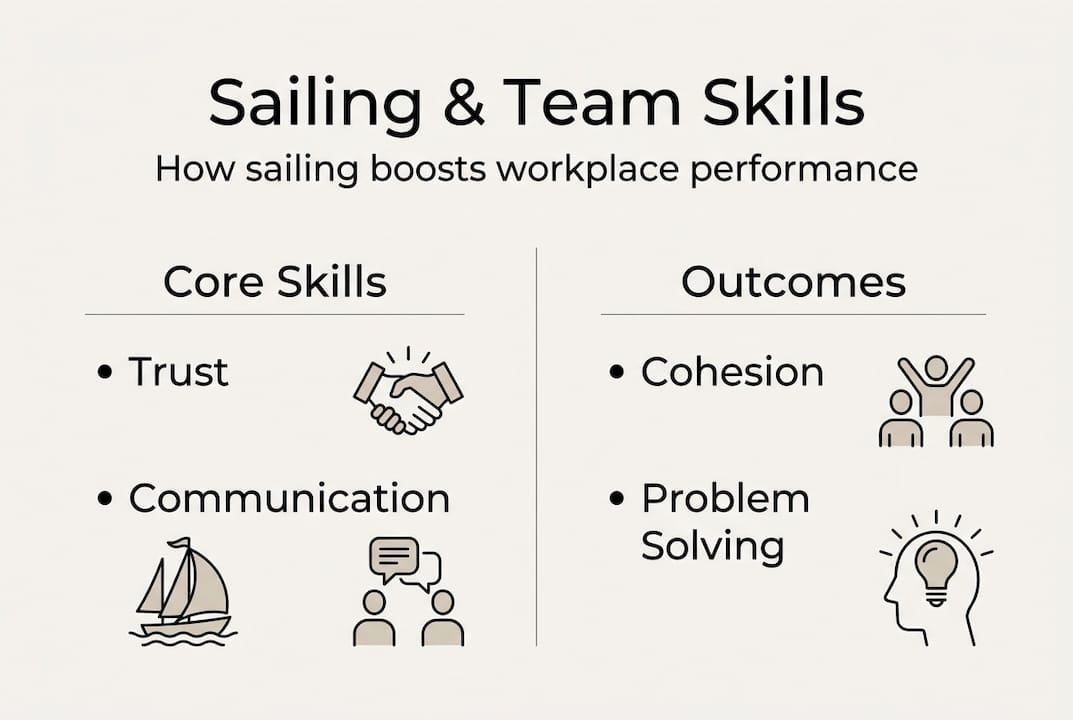
The debrief is as important as the sailing itself. What happens on deck needs to be connected back to workplace behaviour. Without that bridge, the experience remains a pleasant memory rather than a catalyst for change.
Designing inclusive and effective sailing experiences
Understanding the skills at stake, now explore how to design your sailing event for the greatest team impact. The difference between a forgettable day on the water and a genuinely transformative experience comes down to intentional planning.
Inclusive sailing, which brings together participants of varying abilities, places communication and mutual respect at the very centre of the experience. This is not simply a nice-to-have. It is a structural choice that forces every crew member to develop awareness of how their colleagues receive and process information.
Here is a step-by-step approach to planning your event:
- Assess your team’s dynamics before booking. Identify existing tensions, communication gaps, and personality types that need bridging.
- Set specific, measurable goals for the day. “Improve communication” is too vague. “Ensure every crew member gives and receives at least three clear instructions per exercise” is actionable.
- Match personalities deliberately. Place natural leaders alongside quieter team members rather than grouping similar personalities together.
- Rotate roles throughout the day so that everyone experiences both leading and following.
- Run structured debriefs after each sailing segment, connecting on-water behaviour to workplace scenarios.
The table below outlines the key components of a well-structured team sailing retreat:
| Component | Recommended approach | Learning outcome |
|---|---|---|
| Duration | Half-day or full-day | Sustained engagement |
| Role rotation | Every 60 to 90 minutes | Shared leadership experience |
| Debrief frequency | After each major task | Immediate reflection and learning |
| Group size | 6 to 12 per vessel | Optimal crew dynamics |
| Skill level | Mixed, with professional crew | Inclusive participation |
Pro Tip: Ask your sailing provider to assign one professional crew member per group whose sole role is to observe team dynamics and feed insights into the debrief. This turns the experience into structured coaching rather than just recreation.
Exploring yacht team experience ideas in advance helps you select the format that best matches your team’s development goals. For groups that need a private, focused environment, private yacht group tours offer the exclusivity required for candid team conversations and genuine vulnerability.
Unlocking diversity and innovation at sea
A well-designed event unlocks more than skills. It can change the very fabric of your team. Here is how sailing acts as a living laboratory for diversity and high performance.
Diversity initiatives in the workplace often feel abstract. Quotas, training sessions, and policy documents rarely shift behaviour at the level where it matters most: how people actually treat one another under pressure. Sailing changes this because pressure is unavoidable. When a squall arrives or the navigation needs recalculating, there is no time for bias. Competence and clear communication become the only currencies that matter.
Diversity measures may initially feel forced, but they consistently foster high-performing teams over time. Sailing accelerates this process because the environment compresses months of workplace interaction into a single day. Diverse crews, when well-structured, outperform homogeneous ones because they bring a wider range of problem-solving approaches to every challenge.
“Diverse sailing crews are not just more equitable. They are measurably faster, more creative, and more resilient under pressure.”
Here is how to foster genuine inclusion at every stage of your sailing event:
- Brief all participants equally before boarding, regardless of prior sailing experience
- Assign roles based on personality and learning goals, not assumed competence
- Actively create moments where less dominant voices must lead
- Celebrate contributions that fall outside traditional leadership behaviour
- Use the debrief to name and discuss moments where diverse perspectives changed the outcome
Pro Tip: Consider Barcelona sailing group tours that already incorporate mixed-ability and multicultural crews. Observing how professional diverse teams operate gives your group a powerful model to emulate.
The short-term discomfort of navigating difference at sea pays dividends that last well beyond the day itself. Teams that have genuinely collaborated under pressure carry that trust back into the office, and it shows in their work.
A fresh perspective on team building: what sailing reveals
Here is something most team building guides will not tell you. Over-planning is one of the biggest mistakes organisations make when designing offsite experiences. When every minute is scripted, you remove the very conditions that produce genuine learning. Real leadership emerges in the gaps, when the plan falls apart and someone steps up without being asked.
Sailing, done well, builds those gaps into the experience deliberately. Weather changes. Tides shift. The unexpected becomes the curriculum. This is what makes it irreplaceable compared to activities where the outcome is always predictable.
We have observed that teams who struggle most on the water are rarely the ones with the least sailing experience. They are the ones with the most rigid internal hierarchies. The senior manager who cannot take direction from a junior colleague, or the team that has never seen their leader make a mistake, finds the sea genuinely confronting. That confrontation, handled with skilled facilitation, is where the most valuable learning happens.
Traditional team building avoids real stakes because real stakes feel risky. But without stakes, there is no authentic trust. Sailing, as explored through exclusive sailing insights, makes the stakes tangible and the learning permanent. The goal is not a perfect day on the water. It is a team that returns to the office having seen each other differently.
Transform your next team event with a luxury sailing experience
Inspired to try this transformative approach for your own team? At Sphynx BCN, we design group sailing retreats specifically for corporate clients who want measurable outcomes, not just a pleasant afternoon. Our luxury yachts provide the perfect environment for trust-building, leadership development, and genuine collaboration along the Barcelona coastline.
Every element of our corporate yacht event guide is built around your team’s specific goals, from role rotation and structured debriefs to fully catered experiences on board. Whether you are planning for a small leadership group or a large department, our private yacht team tours offer the exclusivity and focus your team deserves. Get in touch to discuss a tailored corporate package and discover what your team is truly capable of when the stakes are real.
Frequently asked questions
How is sailing different from standard team building activities?
Sailing creates genuine real-world pressure that rapidly develops trust, communication, and problem-solving in ways traditional exercises cannot match. Unlike scripted activities, authentic communication at sea is non-negotiable because the consequences of poor coordination are immediately visible.
Can all experience levels participate in corporate sailing events?
Yes. Professional crews design programmes for total beginners and inclusive teams, ensuring everyone can contribute meaningfully to group performance. Tailored, accessible participation is central to how inclusive sailing teams demonstrate their value.
What are best practices for structuring a team sailing day?
Match personalities thoughtfully, set clear and specific goals, rotate responsibilities regularly, and debrief after each session to consolidate learning. Tailored planning and regular debriefs are consistently cited as the foundations of successful team sailing experiences.
Does diversity on a crew really make a difference in performance?
Over time, diverse crews consistently outperform homogeneous groups, even if there is occasional early discomfort during the adjustment period. Diversity measures raise performance long-term by broadening the range of problem-solving approaches available to the team.
Recommended
- Team Building on Yachts: 65% Boost in Cohesion Proven
- Host executive retreats at sea for maximum impact
- How to Host an Unforgettable Corporate Event on a Private Yacht in Barcelona – SphynxBCN Luxury Tours
- Luxury Corporate Yacht Events in Barcelona: A Complete Guide – SphynxBCN Luxury Tours
- RX Global’s Charlie Oxford on Inclusive Leadership for Neurodiverse Teams